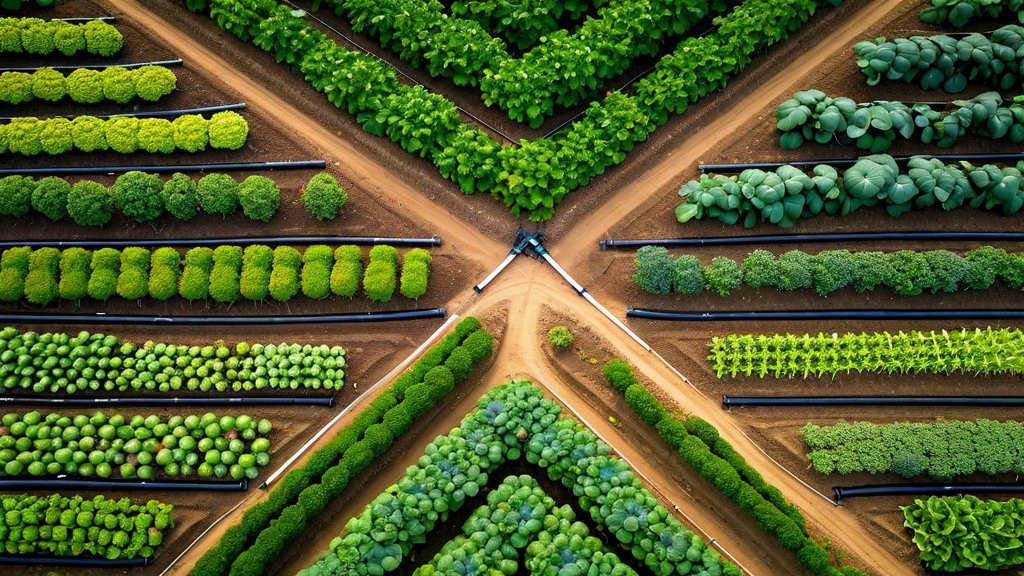
Water is agriculture's most precious and most threatened input. As droughts grow longer and aquifer levels drop across the western United States, the pressure on farmers to use water more efficiently has never been greater. The good news is that the technology to dramatically reduce agricultural water consumption already exists — and the farms that have adopted it are demonstrating reductions in water usage of 35 to 45 percent without sacrificing yield.
Precision irrigation represents a fundamental shift in how farms deliver water to crops. Rather than relying on fixed schedules based on historical averages or farmer intuition, precision irrigation systems use real-time data from soil moisture sensors, weather stations, and crop growth models to deliver water exactly when and where plants need it. The results are consistent and compelling: less water used, lower energy costs for pumping, reduced fertilizer runoff, and in many cases, improved crop quality attributable to more uniform soil moisture.
The Problem with Conventional Irrigation Scheduling
Traditional irrigation scheduling approaches — whether calendar-based, ET-based with generic coefficients, or simply watering until it feels like enough — share a common flaw: they are backward-looking. They apply water based on what happened on average in the past, not what the soil and crop actually need right now. This mismatch leads to chronic over-irrigation in wet periods and under-irrigation during unexpected heat events.
Over-irrigation is more than a waste of water. Excess moisture drives disease pressure, particularly fungal pathogens that thrive in saturated root zones. It leaches nitrogen and other nutrients below the root zone, meaning farmers must apply more fertilizer to compensate. And it compacts soils over time, reducing infiltration and forcing even more water to run off the surface. The economic cost of over-irrigation is substantial, yet it persists because the alternative — continuous monitoring of soil conditions across an entire field — was not practical until the IoT sensor revolution made dense, affordable sensor deployment feasible.
How Soil Moisture Sensors Change the Equation
Modern capacitance-based soil moisture sensors cost a fraction of what they did a decade ago and are reliable enough to deploy permanently in field conditions. Installed at multiple depths — typically 6, 12, and 24 inches — they provide a continuous picture of how moisture is distributed through the root zone. When this data is combined with crop evapotranspiration models calibrated to local conditions, the irrigation system can calculate precisely how much water the crop has consumed since the last irrigation event and how much is needed to refill the root zone to the optimal level without excess.
The most sophisticated systems also incorporate soil texture maps derived from soil sampling or electromagnetic induction surveys. Sandy soils drain rapidly and need more frequent, smaller irrigation events; clay soils hold water longer but can become waterlogged if over-irrigated. A precision system that understands these spatial variations across a field can apply variable rates across irrigation zones, treating each area according to its actual capacity and current condition.
The Role of Weather Forecasting
Perhaps the most impactful innovation in modern precision irrigation is the integration of short-range weather forecasting. If a significant rain event is forecast for tomorrow, there is no reason to irrigate today — yet timer-based systems run regardless. If an unexpected heat spike is predicted to drive evapotranspiration above normal for the next three days, the irrigation schedule should be adjusted proactively, not reactively after crops show visible stress.
Precision irrigation platforms connected to weather forecast APIs can automatically adjust schedules based on anticipated conditions. This alone accounts for a large portion of the water savings achieved by early adopters: simply skipping scheduled irrigation events when meaningful rainfall is imminent eliminates a significant fraction of over-irrigation on most farms.
Real-World Results from Early Adopters
Data from farms operating precision irrigation systems shows remarkably consistent outcomes across diverse crops and geographies. A 480-acre wine grape operation in the Willamette Valley reduced irrigation water use by 41% in its first full season using continuous soil moisture monitoring combined with automated drip system control. Total seasonal yield was within 3% of the previous year — a year without drought stress — while cluster quality metrics actually improved due to more uniform berry sizing attributable to consistent soil moisture management.
A 1,200-acre row crop operation in central Oregon reduced center-pivot water consumption by 38% while maintaining corn yield above the county average. The primary driver was eliminating early-season over-irrigation: sensor data showed that historically the farm had been applying substantially more water than the crop needed during the vegetative growth stages, a pattern invisible without continuous monitoring.
Energy and Input Savings Beyond Water
The financial case for precision irrigation extends well beyond water savings, particularly for farms pumping from depth or at significant head pressure. Every acre-inch of water not pumped saves the energy required to move it. On systems with high pumping lifts, energy can represent 60 to 80 percent of total irrigation operating cost, meaning a 40% reduction in water application translates directly into a proportional reduction in one of the largest line items in the farm budget.
Reduced irrigation also lowers fertilizer input requirements. Nitrogen applied to fields that are subsequently over-irrigated leaches below the root zone and is lost to the crop. Farms that have adopted precision irrigation consistently report reduced fertilizer application requirements after two to three seasons, as the soil biology and chemistry stabilize at healthier baseline conditions.
Implementation Considerations
The path to precision irrigation is more accessible than many farmers realize. The core requirements are soil moisture sensors connected to a data platform, integration with the farm's irrigation control system, and a management interface that makes the data actionable. Existing irrigation infrastructure — whether drip lines, center pivots, or solid set systems — does not need to be replaced. The precision layer sits on top of what is already there.
The most common implementation challenges are connectivity in remote fields and the initial calibration of soil texture and crop coefficient settings. Both are solvable with the right technology partner. Cellular and LoRaWAN connectivity options have expanded dramatically, and a competent agronomic support team can guide the calibration process based on readily available field data.
Key Takeaways
- Precision irrigation reduces water usage by 35-45% by matching water application to actual soil conditions rather than fixed schedules
- Soil moisture sensors at multiple depths provide the continuous data needed to optimize irrigation timing and volume
- Weather forecast integration eliminates unnecessary irrigation before rain events — one of the highest-impact efficiency gains
- Energy and fertilizer savings add substantially to the financial return beyond water cost reduction
- Existing irrigation infrastructure does not need to be replaced — precision systems overlay on top of current equipment
Conclusion
The 40% water reduction figure is not aspirational — it is an average outcome documented across dozens of farm deployments using precision irrigation technology. As water costs rise, regulatory mandates tighten, and the economic case for efficiency strengthens, precision irrigation will move from a competitive advantage to a standard operating practice across production agriculture. The farms that adopt it early are building operational resilience while improving their bottom line today.